

When people try to figure out where in Europe they can build a strong tech career and still feel okay day to day, a few cities tend to rise to the top. For 2025, the most reliable picks are Berlin, Amsterdam, Lisbon, London, and Stockholm. They each offer steady hiring, clear-enough visa paths, and a way of living that doesn’t wear you down. The mood and price point vary from place to place, of course, but these five consistently give international engineers the best mix of opportunity and a life that stays balanced.
Find Visa-Sponsored & Relocation Jobs Worldwide
Searching for global opportunities? Explore verified remote, relocation, and visa-sponsorship jobs curated to help you move your career forward.
Explore JobsWhat Makes a City Great for Tech Careers?
Finding a good city for tech work often has less to do with hype and more to do with what life actually feels like in-between the hours spent working. Cities that support international engineers tend to get several things right at the same time; reliable infrastructure, straightforward public transport, a healthy number of roles for different tech stacks, and an environment where foreign talent doesn’t need two years to feel “local enough” to function.
There’s also the intangible part of it, the almost off-hand details that make certain cities easier to settle into: grocery stores open late enough to catch you after a long sprint cycle; communities that don’t treat newcomers like temporary visitors; neighborhoods where it’s possible to rent a decent apartment without waiting lists that feel like a lottery. Some European cities manage to strike a balance between career opportunity and the soft edges of life (parks, cafés, safety, late-night transport) while others still feel like they’re catching up.
As Europe continues positioning itself as a serious tech region, the hiring map shifts in small waves. Remote work changed things. Venture capital patterns changed things. Even cultural expectations changed, engineers increasingly want places where work matters but life outside work matters just as much.
Top 5 European Cities for Tech Talent in 2025

Berlin (Germany)
Berlin has a way of being welcoming without trying too hard. It’s an odd mix of creative energy, technical ambition, and effortless casualness. Tech professionals who land here usually notice how quickly they can move around the city, explore different neighborhoods, and meet people working in wildly different fields who somehow intersect in a shared café. Offices speak English freely, sometimes even by default, and multicultural teams aren’t an exception, they’re basically the standard.
Career options span the usual categories (backend, frontend, cloud, DevOps, data engineering, AI) but Berlin also leaves room for eccentric early-stage startups that care more about curiosity than perfect LinkedIn profiles. Salaries sit in the middle of Europe’s range, but cost of living, especially outside the most in-demand districts, can still feel reasonable. The city carries the sort of imperfections that make it easy for newcomers to adjust without feeling like outsiders.
The EU Blue Card process remains a relatively stable route for skilled workers. Once settled, Berlin tends to reward people who enjoy a mix of structure and organized chaos.
Amsterdam (Netherlands)
Amsterdam operates on clarity. Good public transport. Predictable work environments. English spoken without hesitation. For an international tech professional who prefers things to work smoothly without too much improvisation, the city becomes a comfortable base.
Tech roles lean toward AI-driven logistics, fintech, clean-tech, med-tech, and well-funded SaaS companies. The hiring environment is structured, and companies typically define expectations clearly. Salaries sit at a reassuring level, which helps soften the reality that Amsterdam’s rental market requires quick decisions and occasionally a bit of luck. But daily life overall feels stable.
The 30% ruling, which reduces taxable income for many international hires, is still one of Europe’s strongest incentives and remains a deciding factor for engineers comparing Amsterdam with cities like Berlin or Stockholm. Combined with the Highly Skilled Migrant Visa, the relocation process tends to feel manageable rather than overwhelming.
Lisbon (Portugal)
Lisbon has a warm, easygoing feel to it, and many visitors or immigrants find it surprisingly welcoming right from the start. But beneath the relaxed exterior, the tech ecosystem has grown in a surprisingly solid direction. Startups in AI, climate tech, e-commerce, and digital mobility keep popping up, and remote-first European companies continue choosing Lisbon as a southern HQ.
International teams are common, which reduces friction for newcomers starting fresh. Costs have risen, especially in central districts, yet day-to-day expenses outside of rent often remain gentler than in northern capitals. There’s something about Lisbon’s pace that balances out stressful sprints and tight deadlines.
It’s the blend of climate, community, and growing career options that keeps Lisbon on the radar for developers wanting a healthier work-life ratio without stepping away from meaningful tech work.
London (UK)
London is unmatched in the sheer volume of opportunities across tech sectors. Anyone looking for large-scale infrastructure, deep AI research, hardcore fintech, or high-complexity cybersecurity work might find options here they wouldn’t easily find elsewhere in Europe.
Salaries sit at the top end, which helps, because rent requires strategy, patience, and sometimes compromise. The Skilled Worker Visa remains the standard path for international developers. Once approved, the process stabilizes.
London rewards ambition and adaptability, but it can also drain energy if someone isn’t selective about where they live or work. Still, it maintains a magnetic pull because it’s one of the few European cities where career acceleration can happen very quickly.
Stockholm (Sweden)
Stockholm has a quieter confidence. It doesn’t need to impress anyone loudly. Its tech ecosystem is structured, steady, and grounded in long-term thinking. Companies here care about good design, thoughtful systems, and sustainable tech practices, qualities that attract engineers who value craftsmanship over noise.
The city is clean, safe, and well-organized. English works nearly everywhere, and neighborhoods feel intentionally designed. Salaries are strong relative to cost of living, though the rental system can be a puzzle during the first months. Many newcomers jump between short-term apartments before settling into something permanent. But once routines form, life becomes smooth, predictable transport, nature nearby, teams that don’t glorify burnout.
Stockholm’s tech strengths sit across fintech, climate-tech, AI, digital entertainment, and enterprise software. Teams often favor collaboration and structured workflows, making it a stable environment for developers who prefer clarity over chaos.
Average Salaries, Rent & Visa Opportunities
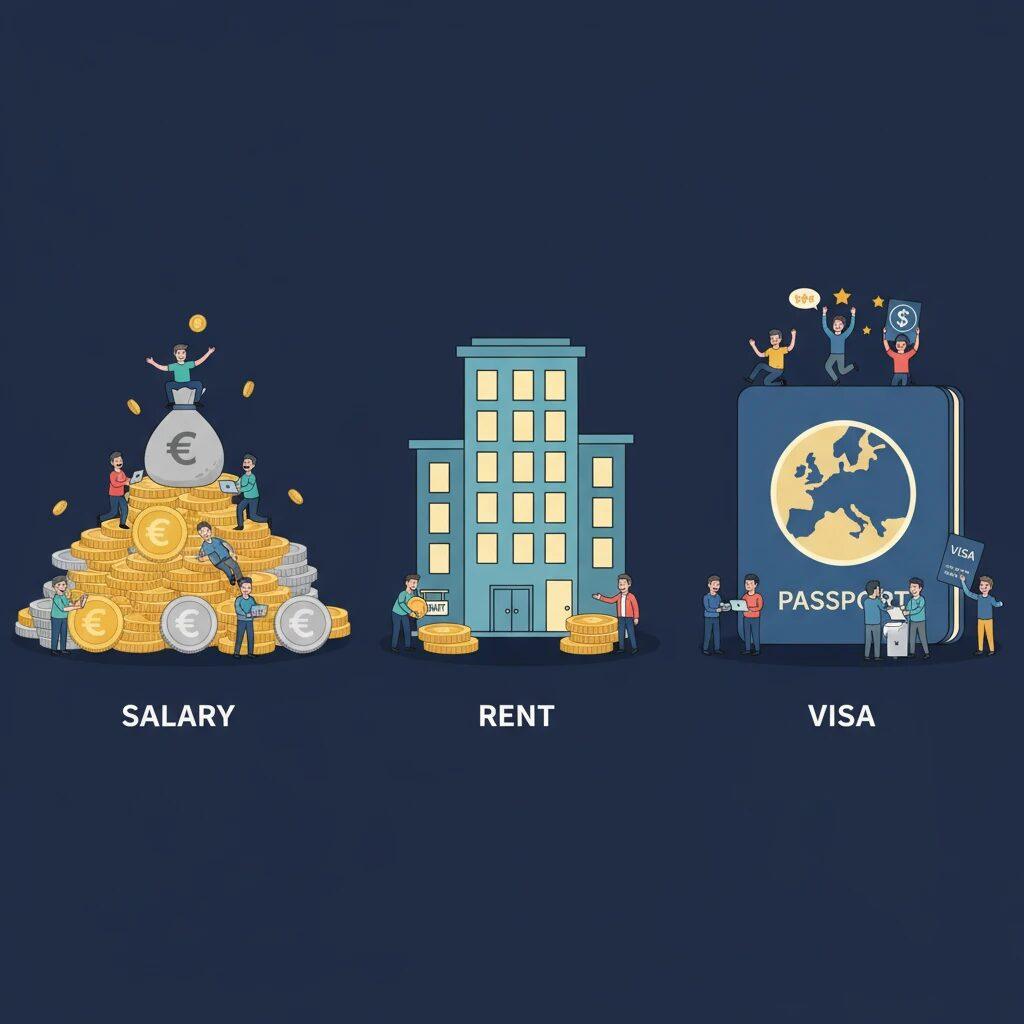
Comparing European cities often comes down to “salary minus rent,” because the gap between earnings and housing varies wildly. London wins on salary but loses on affordability. Amsterdam and Stockholm offer competitive pay with high-quality public services. Berlin sits in a comfortable middle, not the highest salaries, but often the best balance between pay and cost. Lisbon offers lower salaries overall, but everyday expenses, climate, and lifestyle fill some of that gap.
Visa systems affect decision-making more than many people admit. Germany’s EU Blue Card remains reliable, especially for mid-to-senior engineers. The Netherlands offers a smooth Highly Skilled Migrant system plus the 30% ruling. Portugal’s Tech Visa supports companies hiring foreign specialists. Sweden’s work permit framework is predictable once documentation is properly organized. The UK’s Skilled Worker Visa is direct but tied tightly to employer sponsorship.
Meanwhile, rent varies dramatically. Amsterdam and Stockholm struggle mainly with availability. London challenges budgets. Berlin and Lisbon offer better flexibility, though rising demand has started reshaping their markets too. These differences matter, sometimes more than the buzz around a trending tech hub.
How to Find Jobs in These Cities via Jaabz
Searching for jobs across countries can feel like juggling too many tabs at once. Each city has its own rules, its own salary logic, and its own sometimes-unwritten expectations. Jaabz simplifies that mess by curating roles that already accept international applicants and provide visa assistance or relocation help. Instead of scrolling through listings that eventually lead to “unfortunately, we cannot sponsor visas,” candidates get a filtered, realistic view of what’s actually available.
Jaabz listings typically include the details foreign professionals look for, relocation scope, tech stack maturity, visa sponsorship, the range of salaries, and whether the company has previous experience hiring abroad. It reduces the guesswork and makes the early steps of relocation planning less stressful.
Engineers comparing Berlin with Amsterdam or Lisbon with London can see clear differences in cost of living, expected rent, and local job market behavior. Jaabz adds these city-level notes so candidates can evaluate both the job and the environment they might move into. For many applicants, it becomes less about “which job pays more” and more about “which city fits the life I want to build.”
Companies that post on Jaabz often have established processes for onboarding foreign talent, making the transition smoother, fewer surprises, fewer guessing games, and far fewer dead ends.
Conclusion
In the end, choosing the right city comes down to what feels workable for your career and your everyday life. Berlin, Amsterdam, Lisbon, London, and Stockholm each bring something solid to the table, even if they’re different in mood and cost. For most international tech professionals, these five are the places where building a career doesn’t mean sacrificing your balance, and that’s really the point of the whole search.
FAQ
Berlin and Amsterdam are usually the easiest because companies there are very used to hiring internationally and the visa steps are pretty straightforward.
It depends on the city. London pays the most but costs the most, while places like Berlin or Lisbon feel more balanced for everyday expenses.
Timelines vary, but most skilled‑worker visas take anywhere from a few weeks to a couple of months once you have a job offer.
Amsterdam and Stockholm are often the easiest because so many teams operate in English, and daily life doesn’t feel like a struggle for newcomers.
It’s possible, but more competitive. Mid‑level and senior engineers get sponsorship faster, while junior roles may require patience or strong portfolio work.


The idea that certain cities can offer international engineers “the best mix of opportunities” really stood out to me. As someone who’s passionate about scuba diving and snorkeling, I’ve noticed that just like a healthy reef requires the right balance of factors, a city’s quality of life and tech career prospects are also deeply intertwined. I’ve observed that cities with a high quality of life, like those mentioned in the post, often have a strong focus on work-life balance, which can be a major draw for tech professionals. For instance, I’ve heard that some cities have implemented policies to reduce the average commute time to under 30 minutes, which can have a significant impact on overall well-being. I wonder, what role do you think factors like commute time and access to outdoor activities play in making a city attractive to tech talent, and how might this influence the ranking of the top cities in the future?
Loved the reef analogy! I completely agree. Factors like easy commutes and nature access are crucial now. Tech talent is definitely choosing lifestyle and well-being over just high pay. Thanks for reading and adding your thoughts!